
Best Way to Get Around Bali and Eating Well: From Private Drivers to Grab and Gojek Delights
During our first week on the island, I thought getting around Bali would be a logistical nightmare, a sun-soaked obstacle course of scooters, narrow streets, and digital confusion. This story was about how we figured out the best ways to travel in Bali—how we moved, ate, and paid our way through the island without losing our sanity or our Wi-Fi signal.

We started strong, with misplaced confidence and a hired driver. Because really, when you were new somewhere, nothing said “cultural immersion” like sitting in the back seat of an air-conditioned car while someone else navigated the chaos. The plan was simple: a short 30-mile ride across Denpasar. On the map, it looked like a pleasant drive. In reality, it was a 90-minute slow dance through traffic that moved like molasses wearing a helmet.
At first, the roundabouts looked terrifying, as if someone had combined bumper cars with spiritual surrender. But then I noticed something—nobody was angry. Scooters flowed between cars like fish through coral, horns chirping in friendly bursts. It wasn’t chaos; it was choreography. Every driver seemed to know their place in the ballet.
Cary watched with the intensity of a man trying to decode divine order. Meanwhile, I wondered if our driver charged extra for philosophical revelations. Somewhere in the background, incense burned, and someone was definitely frying something that made me question all my life choices leading up to not eating it.
Eventually, we learned the rules. If you wanted to get anywhere in Bali, you hired a reliable driver and always had cash—or better yet, used apps like Grab or Gojek. They saved you from both haggling and heatstroke. You can find more of my Indonesia Practical Info blog—covering money tips, etiquette, transportation, and everyday travel hacks and you can explore more stories, travel tips, and local insights in my Bali blog.
Private Drivers in Bali: The Secret to Sanity and the Best Way to Get Around
Hiring a private driver in Bali was the best way to get there and back. It saved us the headache of navigating traffic, finding parking, or pretending to enjoy the “local driving experience. So we met Pak Wayan. Calm as a monk, punctual to the minute, and blessed with the patience of someone who had definitely waited for confused tourists before. He arrived in a spotless car and somehow remained unbothered while we wandered the Water Palace for three hours, taking the same photo from slightly different angles.
Cary liked the efficiency.
“I love this system,” he said. “No need for me to find the correct turn, no stress.”
“I love that we’re not one wrong turn away from becoming an international headline,” I said.
After sightseeing, Wayan suggested lunch. Five minutes later, we were at a restaurant that had both nasi campur and air conditioning. That combination alone felt like a miracle.
Hiring a private driver was the best way to get there and back. It saved us the headache of navigating traffic, finding parking, or pretending to enjoy the “local driving experience” that usually felt like a near-death simulation. We just sat back, let someone else handle the chaos, and actually enjoyed the view—or napped through it, depending on how ambitious the day looked. It was cheaper than summoning rides all day, and they waited while we sipped coffee, shopped, or argued with ourselves about buying a giant carved turtle. We paid a set rate for the day—around 780,000 to 850,000 rupiah (about USD 40–50) for 10–12 hours.
Tipping usually came when the service was good, but I often gave the private driver lunch money while he waited for us to finish errands or sightseeing. It seemed fair—he spent hours idling in the heat while we drifted through shops or sipped smoothies. A small gesture, really, but it kept the mood relaxed and respectful. A fed driver was also far more patient when we asked for that one last, unplanned stop on the way back. We gave around 25,000 rupiah in town, or 50,000 if we’d hauled him deep into tourist country. No one expected it, but it always earned an easy smile and that quiet, satisfied sense of having done the right thing.
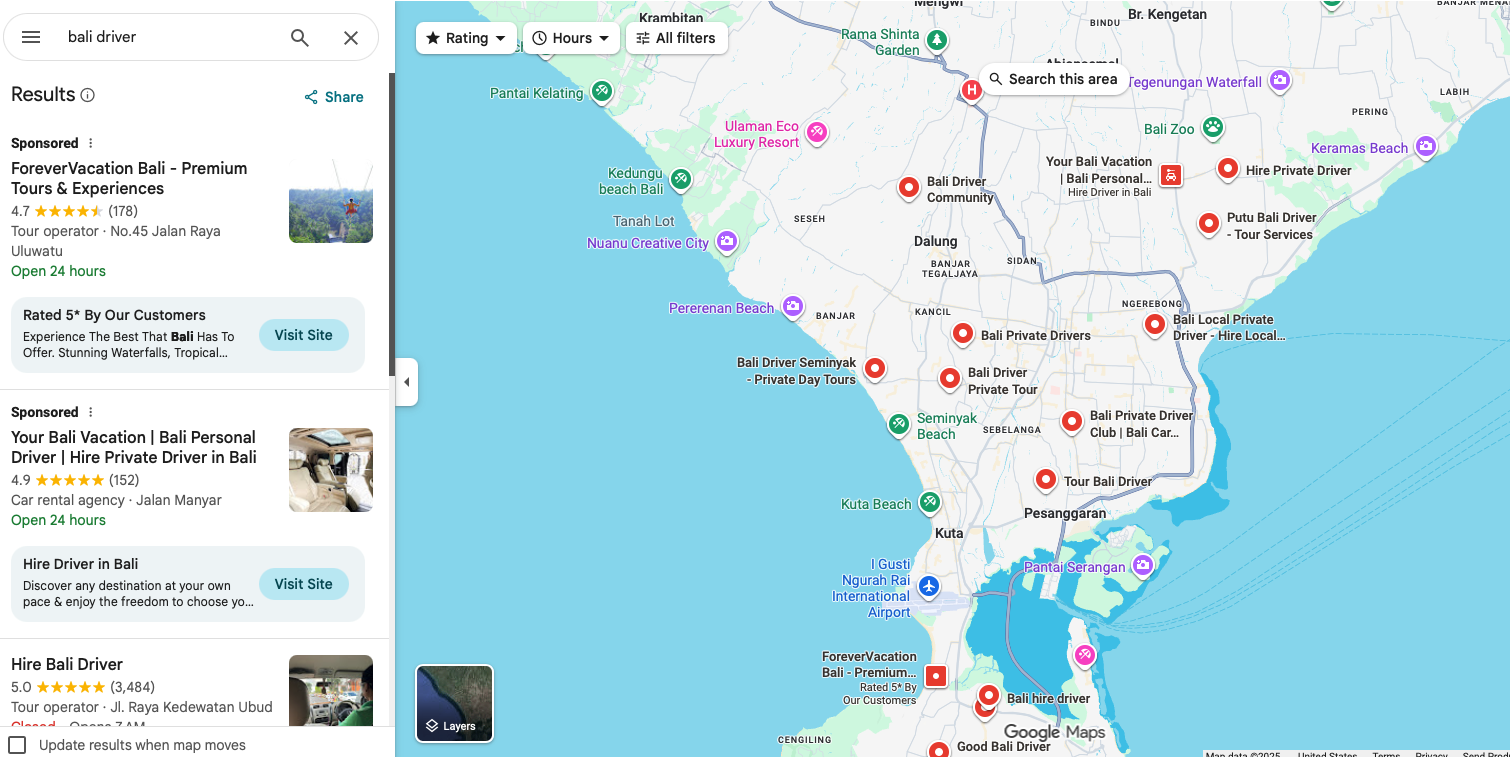
Finding a Private Driver in Bali
The easiest way to find a reliable driver is through Google Maps. Type the area you are in—say, Denpasar—then search for Bali driver. You’ll see plenty of listings with reviews and contact details. Read the comments before you book; locals and travelers usually leave honest feedback. Once you find someone you like, message or call them directly on WhatsApp. Most drivers reply quickly, and many speak enough English to confirm your plans without confusion.
Grab and Gojek: Bali’s Must-Have Travel Apps
When we weren’t hiring a private driver, Grab and Gojek in Bali became our best friends. They were Indonesia’s version of Uber, offering rides, food delivery in Bali, groceries, and courier service—all in one app. Once, I asked a friend who owned a traditional boutique where to buy klerek, the natural soap used to wash batik sarongs. Instead of giving directions, she sent some through GoSend to my villa, one of Gojek’s delivery services, free of charge. That was Indonesia for you—helpful, spontaneous, and casually generous.
The first time we used Grab, Cary typed our hotel name with the confidence of a man who trusted autocorrect. Five minutes later, the driver called through the app, laughing gently, to ask why we had pinned a rice field. We got it right on the second try.
We usually paid by credit card. It kept things simple and spared us from fumbling with rupiah like confused magicians. Some hotels and malls didn’t allow app pickups at the main gate, so we had to meet our driver a few steps away. We just followed the sea of green jackets and helmets, each driver balancing a phone, helmet, and entire lunch order with circus-level precision.
Gojek worked the same way, with its wallet called GoPay. Locals used GoPay and GrabPay for nearly everything, both tied to Indonesian bank accounts. Travelers could still ride or order easily with a card or cash. Prices were low, service quick, and every driver we met was polite and unflappable. One even handed us a printed receipt and bowed slightly—a touch of ceremony for a trip that cost less than our morning coffee.
Scooters: Lovely in Photos, Terrifying in Reality
Every influencer on Instagram looked like they were gliding through paradise, hair flying, sunglasses perfectly aligned, scooter humming under a golden sky. What they never showed were the potholes big enough to swallow your flip-flop, the endless traffic, or the occasional rooster with a death wish. And if you ever wondered, “Is it safe to ride a scooter in Bali?”—for most visitors, the honest answer was no.
We didn’t ride scooters in the US, and we saw no reason to start in a place where traffic moved like liquid. Scooters were convenient if you were local and experienced, but for visitors, they were risky. You needed an international license, good insurance, and nerves of steel. Furthermore, as seniors, it took us about three minutes just to climb on and another five to get off without pulling a hamstring or taking the scooter down with us. Not to mention that we might have been prone to accidents. Healthcare wasn’t cheap and not always up to the standards we expected back home. A hospital visit could turn a small mishap into an expensive headache, especially if you needed private care or evacuation. It was better to skip the scooter adventure and keep both your wallet and your bones intact.
Cash, Cards, and the Great ATM Adventure
Bali still ran on cash—colorful, soft bills that looked like Monopoly money and made you feel rich until you realized 100,000 rupiah was about six dollars.
Before our first trip, I went to the bank in the US and asked for “nice, crisp hundreds.” The teller looked confused but obliged. In Bali, money changers inspected bills like museum curators, rejecting anything with a wrinkle.
These days, we skipped the exchange counters and withdrew cash directly—one of our top Bali travel tips for first-timers. We used Charles Schwab debit cards from the American bank that refunded ATM fees worldwide. You could even open more than one account. I liked having a plan B, just in case an ATM ever swallowed my card—I still had another way to pull out cash.
I write more about navigating money in Indonesia—how to handle cash, cards, and all the small quirks that come with the rupiah—in my blog on traveling smart with money in Indonesia.
Dinner by App: Ordering Food in Bali with GoFood and GrabFood
When we discovered that both apps delivered food too, it was the end of our home-cooking phase. Ordering food in Bali through GoFood and GrabFood became our unofficial kitchen.Feeding whatever cravings we invented that day. Sometimes it was fried chicken, other times sate ayam, or a slice of chocolate cake that absolutely no one needed but everyone wanted. Whatever we ordered, it arrived just right—hot or cold or somewhere decadently in between—perfectly wrapped and carrying that unmistakable aroma of instant gratification.
We started small, ordering breakfast from a warung nearby. The driver, wearing the classic green Gojek jacket, arrived balancing one coffee, one smoothie, a paper bag of banana fritters, and what looked like rice with something. He somehow managed all that on a scooter without spilling a drop or looking remotely stressed. Cary tipped him extra and muttered, “That man deserves a logistics award.”
From there, it escalated. One night, we ordered grilled fish from a beach shack in Sanur—forty minutes away. “They’ll never deliver that far,” I said. Cary, ever the optimist, shrugged. “This is Asia. Everything’s possible.” Forty-five minutes later, our driver arrived, cheerful with a big smile on his face. The fish was warm, the rice fluffy, and the sambal nuclear. We took one bite and both made the same involuntary squeak. Lesson learned: always type tidak pedas(not spicy) in the notes if you valued your taste buds.
What fascinated us most was how seamlessly locals lived through these apps. Our Balinese friend Anita laughed when she saw us walk to a café. “Why go out?” she said. “GoFood can bring it!” For her, the app wasn’t a convenience—it was a lifestyle. She used it for everything: meals, groceries, even sending fresh fruit to her mother’s house.
One afternoon, I asked Anita what brand of mosquito repellent I should buy. Before I could even Google where to get it, she had already ordered some through GoSend, Gojek’s courier service. Twenty minutes later, a man appeared at the gate with two bottles and a grin that said he’d just rescued us from itchy misery.
Ordering Like a Local in Bali
We learned the rhythm quickly. Both apps worked beautifully with credit cards, and we never needed a local bank account—another key Bali travel hack for visitors. GoPay and GrabPay were popular with locals, but for travelers, cards or cash worked fine. Drivers loved cash tips; even 10,000 rupiah—roughly sixty cents—could earn a grin and a heartfelt thank-you. However, I sometimes gave them tips using the credit card that I attached to my Grab or Gojek accounts.
Finding drivers sometimes took a little navigation art. Villas in Bali hid behind unmarked lanes called gangs, so your pin often landed in a rice field instead of your door. One driver once laughed, “Madam, you live in the jungle?” Technically, yes. But we met him at the nearest temple, which in Bali was never more than fifty meters away.
When our food arrived, it was polite to say, “Terima kasih, Pak” (thank you, sir) or “Makasih ya” for casual warmth. Every single driver smiled and replied, “Sama-sama,” meaning “You’re welcome.” There was something charming about getting your dinner with a small slice of human kindness.
We once ordered two iced coffees and a coconut pancake during a rainstorm. The driver arrived soaked, but everything inside the bag was perfectly dry. I asked how he managed that. He just grinned. “Magic, Bu.” I believed him.
What You Could Get
GoFood wasn’t limited to fast food—it was an edible map of Bali.
Warung Wardani in Denpasar served legendary nasi campur—a perfect balance of shredded chicken, sate lilit, crispy shrimp, and sambal that proved simplicity still ruled Bali’s food scene.
Restoran Renon in Denpasar had built a reputation for solid halal Chinese-style cuisine—dim sum, salted-egg-yolk green beans, and sweet-savory noodles—all at very friendly prices.
Bebek Bengil in Ubud was famous for crispy duck that crackled louder than the evening cicadas.
Most deliveries cost less than a dollar in fees. And if you were lucky, your driver might have thrown in an extra sambal packet “just in case.”
When Apps Met Culture: The Balance of Tradition and Technology in Bali
Bali was a paradox—temple offerings on the ground, while dinner showed up by app. There was a quiet harmony in how modern convenience coexisted with deep tradition. You could sit on a veranda surrounded by rice paddies, hear a rooster crow, and five minutes later, your phone buzzed: “Your driver is nearby.”
One evening, Cary looked at our screen as a little green scooter icon zipped across the map. “Somewhere out there,” he said, “our dinner is riding through the rain.”
He paused, watching the tiny dot move closer.
“Kind of poetic, isn’t it?”
“Romantic,” I said. “Until you realize it’s bringing sambal that could remove wallpaper.”

Pro Tips: Ordering Like a Local
Download both Grab and Gojek. Some restaurants only appeared on one app.
Use Google Maps to check restaurant reviews before ordering.
“Es” meant iced. So “kopi susu es” = iced coffee with milk.
Keep small bills for tips.
For faster delivery, order from places within three kilometers.
Always double-check your villa pin—you might save your driver a spiritual crisis.
Pro Tips: Transportation in Bali
Hire a driver for full-day trips.
Download both Grab and Gojek.
Always double-check your pickup pin.
Use Google Maps for timing, not truth.
A “30-minute” trip on the map can easily stretch to ninety. Traffic near Denpasar, Canggu, or Ubud has its own spiritual pace.Buy a local SIM card or eSIM on arrival. Apps like Grab and Gojek rely on data, and Bali’s Wi-Fi can vanish faster than your sense of direction.
Balinese drivers stay calm even in the thick of traffic. A friendly Makasih ya (thank you) goes a long way. Understanding Balinese culture means noticing that quiet ease—the unspoken rhythm that keeps Bali moving. I write about that cultural balancing act in my blog—how Indonesian etiquette shifts from person to person, and how every polite moment comes with its own set of surprises.
Useful Links
Gofood site: https://gofood.co.id/en
Grabfood site: https://food.grab.com/
Grab food is available in Indonesia, Singapore, Philippines, Malaysia, Vietnam, Thailand, Myanmar, and CambodiaGojek: https://www.gojek.com/en-id
Some Balinese Words
Matur Suksma (Mah-toor sook-smah) = Thank you
Mewali (Meh-wah-lee) = You are welcome
Pamit (Pah-mit—with a soft “t”) = Goodbye
Nggih (ng-gee, with a soft “ng” like in “song”) = Yes
More Travel Stories
More travel stories from our travels, along with Bali hotel reviews we loved sharing. Think of it as the rack where all our Indonesia-Bali stories hang together, so everything is easy to find.
Keep scrolling to see our latest posts or use the search box to search Bali topics